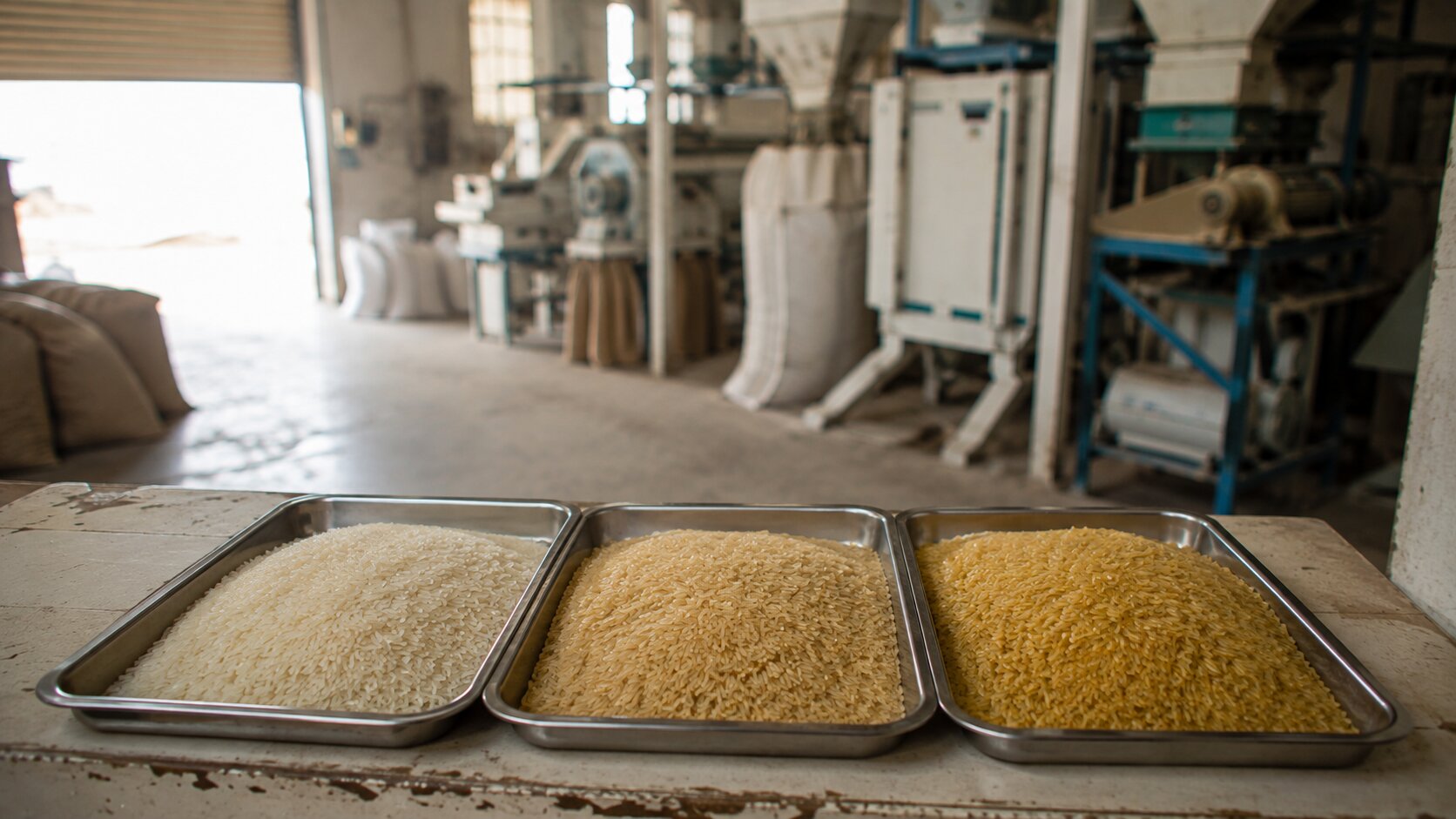
Ask an exporter for basmati rice and the next question back is almost always “which processing?” — because Raw, Steam, White Sella and Golden Sella aren’t quality grades, they’re genuinely different products with different cooking behaviour, shelf life and buyer expectations.
Raw
Raw basmati is milled straight from the paddy without any pre-cooking (parboiling) step. It has the cleanest, whitest appearance and the most delicate aroma of the four, but it’s also more prone to breakage during milling and transport, and cooks to a softer, slightly more fragile grain. Raw is the standard choice for buyers whose end customer expects “plain white basmati” — most retail and home-cooking demand falls here. Full Raw processing guide →
Steam (parboiled, white)
Steam rice is parboiled before milling — the paddy is soaked, steamed and dried before the husk is removed. Parboiling drives nutrients from the bran into the grain and firms up the starch structure, which means steam rice is more resistant to breakage, keeps its shape better under repeated reheating, and has a longer shelf life. It’s a common choice for foodservice and catering operations that batch-cook and hold rice for service. Full Steam processing guide →
Golden Sella
Golden Sella is a parboiled rice where the paddy is soaked and steamed in a way that leaves a distinct golden-amber colour before milling and polishing brings it back closer to white (a light golden tinge often remains). It has the firmest cooked texture of the group and the strongest resistance to overcooking or clumping, which is why high-volume kitchens and buffet-style foodservice frequently specify it — it holds up under heat lamps and repeated serving far better than raw rice does. Full Golden Sella processing guide →
White Sella
White Sella is parboiled like Golden Sella, but processed to remove more of the golden colour, landing between raw and Golden Sella in both appearance and cooking firmness. It’s a middle-ground option for buyers who want some of parboiling’s durability benefits without the golden tinge on the plate. Full White Sella processing guide →
Choosing for your buyer
| Use case | Typical choice |
|---|---|
| Retail, home cooking | Raw |
| Restaurant / catering, batch cooking | Steam or White Sella |
| Buffet, high-volume foodservice, heat-holding | Golden Sella |
| Retail wanting a firmer texture without golden tinge | White Sella |
If you’re not certain which fits your market, ask for small samples of two processing types cooked side by side — the texture difference is obvious within one meal, and it’s a far more reliable way to decide than reading a spec sheet.
Every variety in our range — 1121, 1509, 1718 and 1401 — is available across all four processing types, subject to availability. Request a quote and tell us your intended use, and we’ll recommend a processing type alongside the variety. If you’re also weighing fresh-crop against aged stock, see our guide on why aged basmati costs more.